
Psoriatic Arthritis
What is PsA
Psoriatic arthritis is a chronic type of inflammatory arthritis often diagnosed in people with psoriasis. Together, these conditions are commonly known as psoriatic disease.
Studies show that 10% – 30% of people with psoriasis will develop psoriatic arthritis; however having psoriasis does not necessarily mean that a person is subject to developing psoriatic arthritis.
It is possible to develop psoriatic arthritis without having psoriasis however, this is far less common.
Although not everyone with psoriasis will develop psoriatic arthritis, anyone with psoriasis should be alert to the signs and symptoms of psoriatic arthritis because early detection and treatment are key to preventing long-term damage to one’s joints.
Psoriatic arthritis is an autoimmune disease whereby the joints are under attack, causing swelling, pain, warmth, redness and stiffness as well as fatigue. Psoriatic arthritis can appear in any joint or where ligaments and tendons connect to the bone. It can also cause neck and back pain and stiffness.
In a healthy joint (see figure), the synovial membrane, which lines the surface of the joint, produces synovial fluid which is lubricating and nourishing.
In contrast, in an inflamed joint the synovial membrane is filled with immune cells ( T cells and other chronic inflammatory cells) and these cells begin to divide excessively. The immune cells within the inflamed joint produce many pro-inflammatory cytokines (such as TNF, IL-17A) resulting in the recruitment of more immune cells to the membrane and production of cytokines .
A combination of genetics and environmental factors trigger proinflammatory pathways in psoriasis, particularly through Th1 and Th17 cells. These cells release a variety of cytokines, resulting in increased activation of proinflammatory cells in the skin that in turn perpetuate this process. A similar process occurs in the joints in psoriatic arthritis, resulting in initiation and perpetuation of inflammation within as well as near the joints such as at the entheses (see figure).
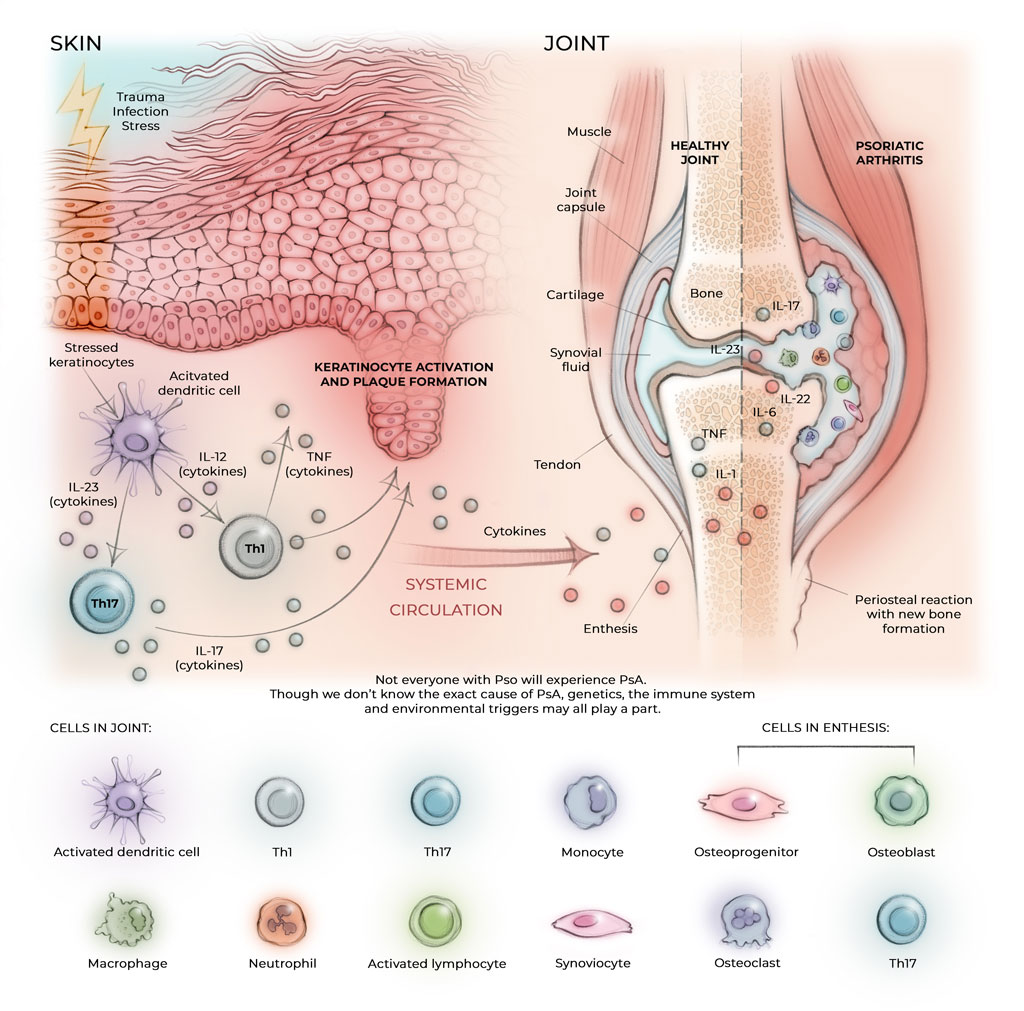
An important feature of psoriatic arthritis is inflammation at the insertion of the tendons and ligaments to bone, termed enthesitis. In the human body, such insertion sites are numerous, e.g., the insertion of the Achilles’ tendon to the heel. Achilles’ enthesitis is thus a relatively common feature of PsA as is enthesitis at other sites.
If left uncontrolled, the disease progresses, and the proliferating synovial membrane cells can become invasive and begin to break down cartilage and bone at the joint. The inflammation can also cause deposition of new bone near the joint, sometimes leading to joint fusion.